
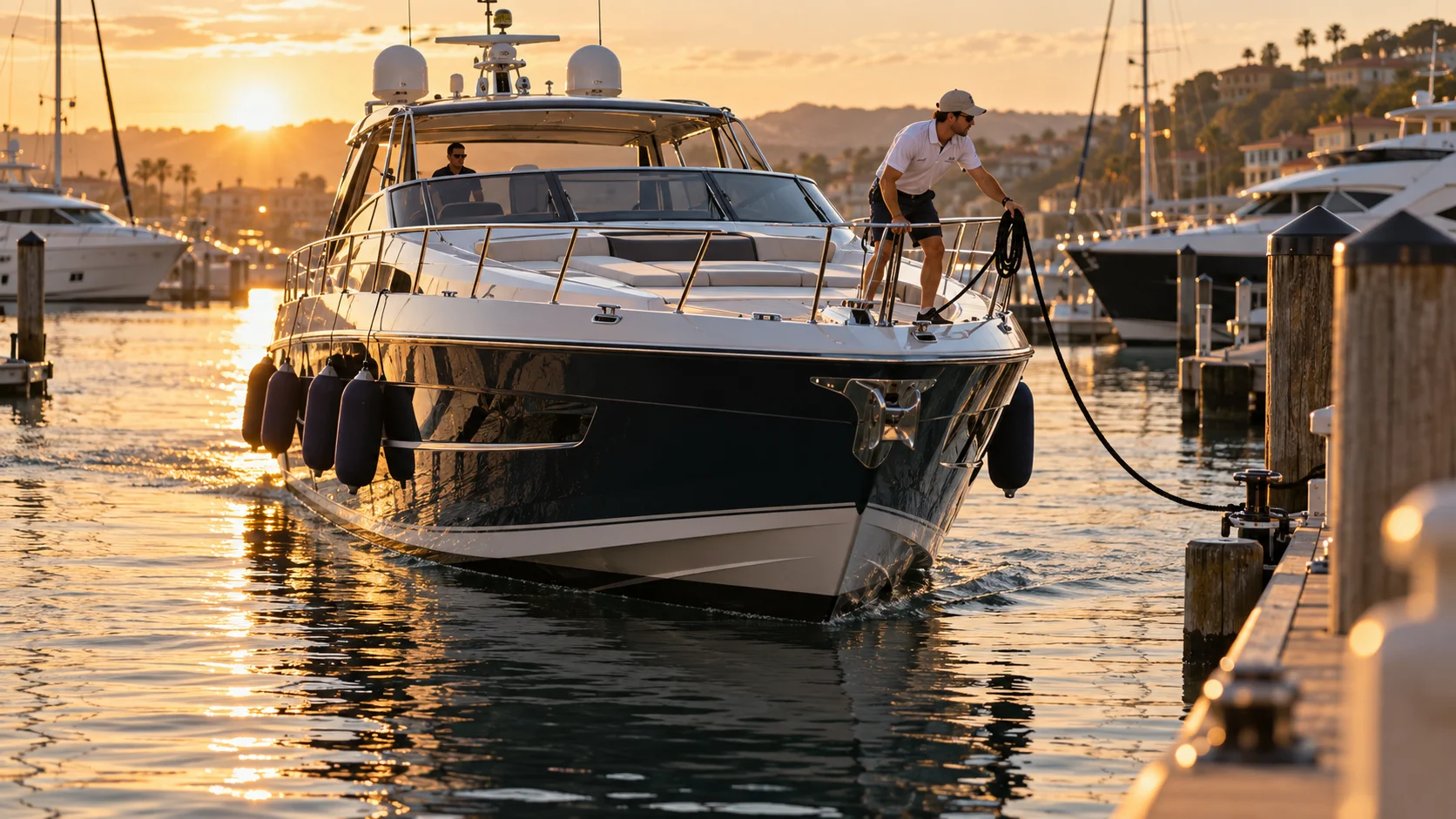
For many boat owners, getting underway is the easy part. The more demanding moment often comes at the end of the trip, when wind, current, limited maneuvering room and a crowded marina all converge around the hull.
That is why understanding the difference between mooring and docking matters. Both are methods of securing a vessel, but they involve different equipment, different techniques and different considerations for safety, convenience and long-term boat care.
Docking means securing a boat directly alongside a dock, pier or slip using lines attached to cleats or pilings. Mooring generally means securing the vessel to a permanent mooring system in the water, usually with a buoy connected to an anchor, block or other fixed point on the seabed.
What Is Boat Docking?
Docking places the vessel directly next to a fixed structure, giving passengers immediate access to land. It is the most familiar arrangement at marinas, yacht clubs, fuel docks and waterfront restaurants.
A properly docked boat is usually secured with a combination of bow lines, stern lines and spring lines. The exact configuration depends on the size of the vessel, the type of slip and local conditions.
Spring lines are particularly important because they help prevent the boat from moving too far forward or backward while tied alongside a dock. Fenders are positioned between the hull and the dock to absorb contact and protect the boat's finish.
Docking offers convenience, especially for owners who frequently load passengers, provisions or equipment. Shore power, fresh water and other marina services may also be available directly at the berth.
What Is Boat Mooring?
A mooring allows a vessel to remain secured away from a dock. Instead of tying directly to a pier, the boat is attached to a buoy or another connection point that is anchored to the seabed.
Moorings are common in harbors where dock space is limited, where waterfront geography makes fixed slips impractical or where authorities want to reduce uncontrolled anchoring.
The vessel generally connects to the mooring using a pennant or bridle attached to a strong bow cleat. Because the boat can swing around the mooring as the wind and current change, adequate spacing between vessels is essential.
Owners using a mooring should regularly inspect the entire system. Chains, shackles, swivels, pennants and underwater components can deteriorate through corrosion, abrasion and repeated loading. A mooring that appears secure from the surface may still contain worn hardware below the waterline.
Mooring vs. Docking: Which Is Better?
Neither system is automatically better. The right choice depends on how the boat is used and where it is kept.
Docking is often more convenient for frequent access. Owners can step aboard quickly, connect utilities and load supplies without using a tender. A slip can also make routine cleaning and maintenance easier.
Mooring can be attractive in protected harbors where slips are scarce or expensive. A properly installed mooring also allows the vessel to orient naturally into the prevailing wind or current instead of being held against a fixed dock.
The tradeoff is access. Reaching a moored vessel normally requires a launch, dinghy or tender, and boarding can become more difficult when weather conditions deteriorate.
Why Wind and Current Matter When Docking
Successful docking begins before the boat reaches the slip. The operator should identify the direction and strength of the wind and current and determine how those forces will influence the vessel during the approach.
Wind acting on a high-sided boat can push the vessel sideways surprisingly quickly. Current can have an equally significant effect, particularly around narrow channels, marina entrances and tidal waterways.
Whenever possible, approach the dock at a slow, controlled speed. Boats generally respond more predictably when short applications of throttle are used instead of carrying excessive momentum into the slip.
Speed creates problems faster than it solves them. A slow approach gives the operator time to correct the angle, use reverse thrust and allow crew members to prepare lines without rushing.
Use Dock Lines Correctly
Dock lines do more than keep a boat attached to the dock. Each line should control a particular direction of movement.
Bow and stern lines limit lateral movement while spring lines control forward and backward motion. Together, they should secure the vessel while still allowing enough movement for normal changes in water level, wake and weather.
Lines should be inspected regularly for chafing, damaged fibers and hardened sections. Any line that repeatedly rubs against a cleat, chock or piling can weaken much faster than expected.
Chafe protection is especially important for boats that remain docked for extended periods or are exposed to significant tidal movement.
Fender Placement Is Just as Important
Fenders protect the hull from contact with pilings, seawalls and neighboring boats. Their effectiveness depends heavily on placement.
Position fenders where contact is actually likely to occur rather than simply hanging several along the side of the boat. A vessel entering a slip may need protection at the widest section of the hull, while a boat secured against pilings may require fenders at specific pressure points.
Fender height should also account for changing tides and dock elevation. A fender that protects the hull at high tide may become ineffective several hours later if it rises above or drops below the contact area.
Common Docking Mistakes
Many docking problems begin with too much speed. Once a boat carries excessive momentum into a confined area, the operator has fewer options and much less time to react.
Another common mistake is approaching without a clear plan. Lines should be prepared before entering the slip, fenders should already be deployed and crew members should know which line they are expected to handle.
Passengers should also understand that hands and feet should never be used as makeshift fenders between the boat and the dock. A damaged gelcoat surface is repairable. A crushed hand or foot may not be.
Operators should also avoid relying on a single line to control the vessel. Proper line placement distributes loads and keeps the boat from surging unnecessarily as conditions change.
Approaching a Mooring Buoy
Picking up a mooring requires the same patience as entering a slip. The operator should determine the direction of the wind or current and approach slowly, ideally with the bow pointed into the dominant force.
A crew member can then retrieve the pickup line or mooring pennant using a boat hook. Once secured, the connection should be checked to ensure that the pennant is properly attached to a suitable bow cleat and cannot become tangled around the anchor, propeller or other equipment.
The boat should then be allowed to settle naturally on the mooring. Watching how nearby vessels lie can provide useful information about the prevailing conditions and the expected swing direction.
Inspect Before Leaving the Boat
Whether the vessel is docked or moored, the final inspection should never be rushed.
Check every line and connection point before leaving. Confirm that dock lines cannot slip off cleats, fenders remain positioned correctly and shore power cables are properly secured when used.
On a mooring, inspect the visible pennant for chafe and confirm that the boat has sufficient room to swing without contacting nearby vessels, navigation markers or shallow water.
Weather should also influence how the vessel is secured. Forecast strong winds, storms or unusually high tides may justify additional lines, modified fender placement or moving the boat to a more protected location.
Practice Makes Docking Easier
Docking is a boat-handling skill, not a performance. Even experienced captains occasionally abandon an approach and try again when the angle, wind or traffic does not look right.
That willingness to reset is often what separates controlled boat handling from an avoidable collision.
New boat owners can improve quickly by practicing in calm conditions. Learn how the vessel responds to forward and reverse thrust, how quickly it turns at low speed and how wind affects the bow and stern. Twin-engine boats, single-engine boats, sailboats and vessels equipped with bow thrusters all behave differently around a dock.
Understanding those characteristics before entering a crowded marina builds the judgment required when conditions become more challenging.
Protecting the Boat Starts at the Berth
Mooring and docking may happen after the engines slow down, but they are still part of seamanship. Proper lines, sound equipment and a deliberate approach protect the vessel long after everyone has stepped ashore.
The goal is not simply to get the boat tied up. It is to leave it secured in a way that accounts for wind, current, tide, wake and changing weather.
A well-secured boat should be ready for those forces even when nobody is standing on the dock to watch it.